
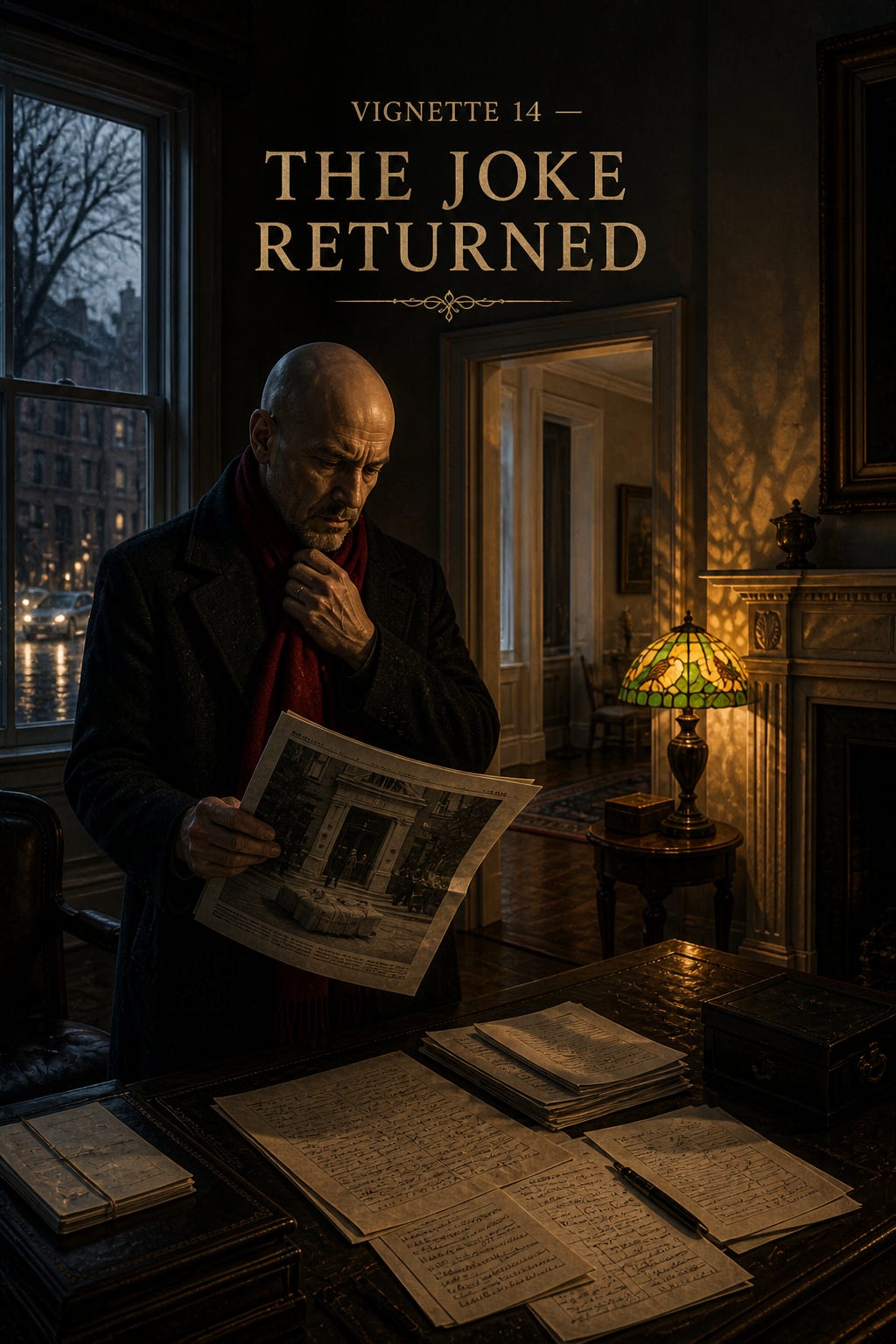
November 9, 1993 — Late Afternoon | 7 Moulder Lane, Boston
The second article arrived folded inside the first.
Isaac found it when he went back to the morning paper, not because he had missed anything the day before, but because the roof breach in Stockholm had stayed with him through the night in the particular way certain methods did. Not as headline. Not as scandal. As geometry. He had gone to sleep with the image of the opening still in his mind and woken to it unchanged, the black mouth in the museum’s roof no less elegant for having been printed cheaply.
Now, in the failing light of late afternoon, with 7 Moulder Lane smelling faintly of dust, drying paint, and the weathered interior of an old house being taught to pass inspection, he stood at the kitchen counter and unfolded the paper again.
This time the photograph was smaller.
A museum entrance.
Two packages left outside.
Officials gathered near them with that species of body language peculiar to institutions—aggrieved caution, as if the objects themselves had violated policy by appearing without appointment.
The article below explained what the caption made obvious enough: counterfeit versions of the stolen works had been returned and abandoned outside the museum in a gesture so juvenile, so theatrical, that most readers would have taken it for arrogance and stopped there.
Isaac read every line twice.
The forged works were not good, apparently.
Not good enough to deceive anyone who mattered.
That was not the point.
The point was return.
The point was audience.
He laid the paper flat and leaned both hands on the counter, studying the grainy little image of the packages abandoned at the museum like bad manners.
Behind him, the house moved through the hour in its newly corrected register. From the front room came the dry faint scent of fresh trim and polished wood. Somewhere upstairs, one of the patched walls gave off the chalky smell of recent sanding every time the heat came on. No paws crossed the floorboards. No soft shift of collar, no leap onto wood, no waiting life interrupted the rooms into honesty. The place had been emptied of its warm witnesses and left with only surfaces.
The kitchen clock advanced with cheap certainty.
Isaac kept reading.
Most thefts aspired to silence.
Silence was what separated men who moved objects from men who wanted to be seen moving them. Silence let the wound arrive before narrative clothed it. Silence left rooms to their own shock. It gave police less to resent and reporters less to romanticize. It was, in its way, a form of respect—not for law, never that, but for the work itself. A painting taken cleanly from a wall entered another order of life. It did not need a joke written over it by men too in love with their own nerve.
He turned the page back, then forward again.
The article stayed irritating.
Not because the thieves had mocked the museum.
Because they had needed the museum to know they had mocked it.
That was vanity, not fluency.
He took the paper into the front room.
Twilight had begun doing its usual dishonest kindness to the house. The too-clean windows now held the street in softened bands of silver-gray and diluted gold. The walls, recently painted into better manners, no longer looked so accusing. The front room had entered that brief hour in which most places appeared deeper than they were, gentler than they had been all day, and more willing to host fantasy. Buyers loved such light. It made them sentimental. It allowed them to imagine their better selves crossing thresholds they had no intention of honoring.
Isaac stood by the mantel and reread the Stockholm follow-up standing up.
The paper crackled in the quiet.
He thought of Verbruggen.
Not the man exactly. The method. The old Dutchman had known how to collect insult as well as evidence. Verbruggen understood that thieves talked even when they never spoke aloud. Choice of city. Choice of room. Choice of date. Choice of target. Choice of whether to disappear cleanly or to leave some small smirking trace behind as proof that the institution had not merely been breached, but made ridiculous.
That last kind offended him most.
Not because institutions deserved gentleness. Most of them deserved exposure at minimum. But because performance bred memory, and memory, once agitated, did not always limit itself to the intended spectacle. A joke left at a museum entrance might delight the men who staged it. It might also fix dates, habits, voices, route logic, and appetite into the minds of the very people best equipped to preserve them.
You stole the paintings, Isaac thought. Why teach them how to remember you?
The newspaper in his hand carried the faint smell of ink and contractor tobacco from wherever it had spent the morning before becoming his. He folded it once across the counterfeit-return photograph and then unfolded it again, as if repetition might improve his opinion.
It did not.
The room around him remained still.
The lovebird lamp was off.
The fireplace cold.
The brightened trim behaved itself under dusk.
The house, corrected into plausibility, seemed to listen.
He looked toward the front windows.
Their too-clean panes reflected back the room in pale doubled layers: the mantel, the dark furniture, his own figure holding the paper, half inside the room and half floating in the glass. Outside, traffic passed at the far end of the block in streaks of damp light. Somewhere two houses over, a woman called for someone to come in before dinner and was ignored twice before the door slammed.
Ordinary life pressed on.
It always did.
That was what made gesture so dangerous. The world did not stop to admire a performance. It merely absorbed it, then filed it among its other irritants until someone clever, years later, learned how to sort the file correctly.
He crossed to the chair near the mantel and sat, the paper open across one knee.
The counterfeit packages waited outside the museum in their grainy photograph, absurd and deliberate.
He thought then—not of Stockholm, not of Verbruggen, but of Daniel.
Not the whole memory.
Only the old association of scarlet and aftermath.
The scarf at Isaac’s throat had belonged to Daniel—the first man he had tried to love, and the last man he had let betray him. The wool itself remained untouched, but memory never was. Somewhere behind the thought lay the bed, the crimson geometry spilled into the sheets, the room already turning from intimacy into evidence. Book One had taught that lesson thoroughly enough. Isaac did not need the rest of it now.
Without looking down, he raised one hand and touched the scarf where it lay looped at his throat.
The wool was soft from wear.
The red almost black in the dim room.
Then he rose, crossed to the lovebird lamp, and turned it on.
Green and amber bled slowly across the nearest wall.
The colored light caught the scarf at once.
For one brief second the scarlet deepened under it, becoming richer, darker, almost ecclesiastical. The same bruised interplay of color that made the Tiffany lamp beautiful also made it indecent. It stained the room with memory without having to name any of it outright.
The colors made the newspaper look briefly richer than it was, as if even bad theater deserved stained glass if the light struck it at the right hour.
Isaac stood with one hand still near the scarf, feeling the old wool beneath his fingers and the colored light altering it into something more dangerous than sentiment.
That, he thought, was the difference between a wound and a joke.
A wound did not require an audience.
It went on speaking anyway.
He looked down at the folded article once more.
“Amateurs,” he said softly.
Not because the job itself had been amateur.
Because the need to be seen always was.
He took the paper up again and carried it into the study, where jokes could be filed with the rest of the world’s bad habits and kept until they became useful.
To be continued…
-By Noble Osborn