
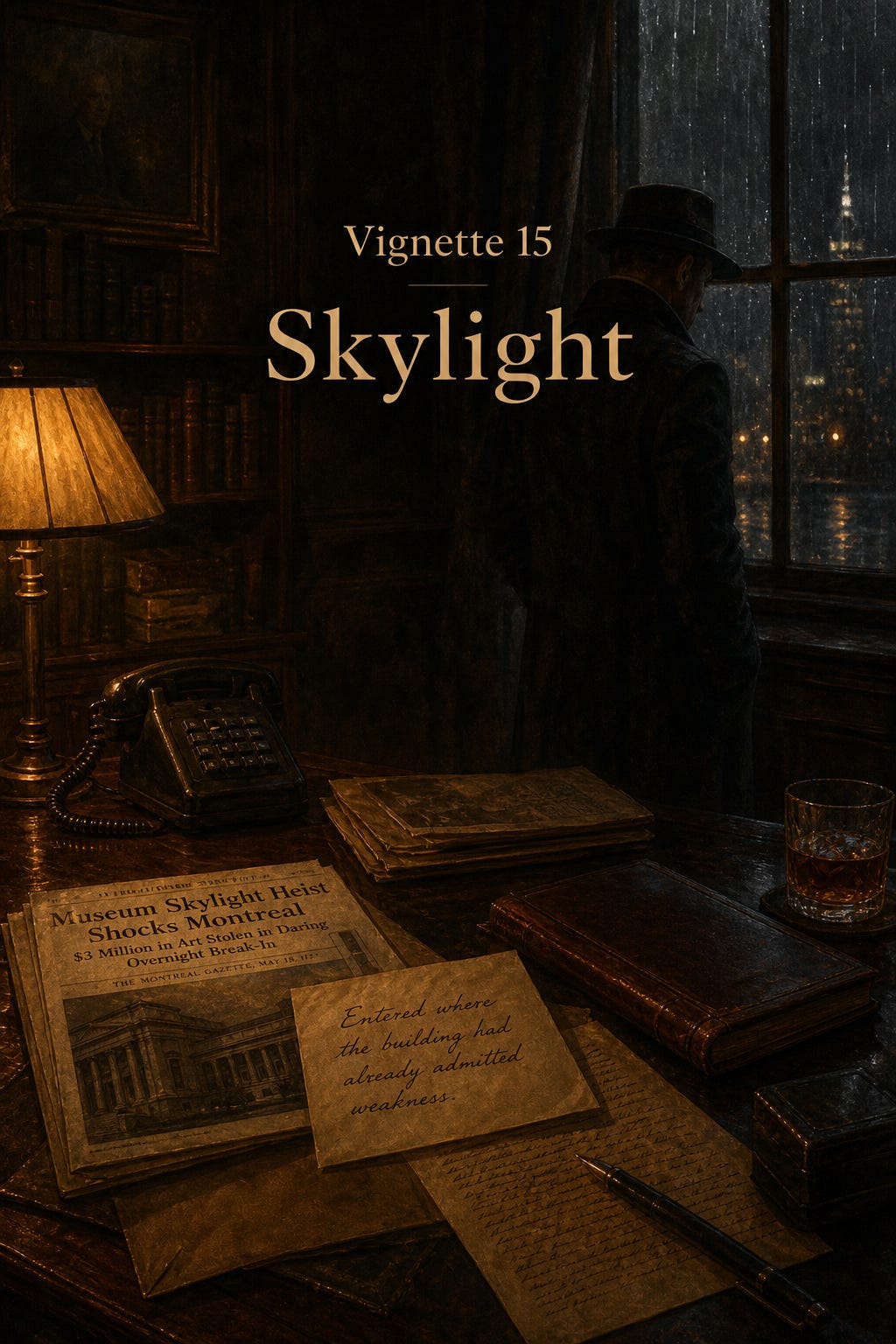
November 11, 1993 — Late Evening | 7 Moulder Lane, Boston / Remembered Montreal, 1972
The word that brought Montreal back was not museum.
Not Rembrandt.
Not security.
Not even theft.
It was repair.
Isaac found it in one of Verbruggen’s margin notes two evenings after Stockholm, written in the old Dutchman’s narrow, disciplined hand beside a clipped reference to the Montreal Museum job from twenty-one years earlier.
Entered where the building had already admitted weakness.
He sat with the page under the study lamp and read the line twice.
Then a third time slower.
Outside, November rain had started again—not enough to sound like weather, only enough to make the windows hold the street in dark ripples and give the city that faintly bruised look Boston wore so well after dusk. The house behind him remained in its corrected pose: front room brightened into plausible innocence, hallway patched, trim newly obedient, all of it learning how to flatter strangers. The study resisted better than the others. It always had. Even improved, it still smelled of cedar, leather, old paper, and the accumulated private weather of decisions made without witnesses.
Earlier that evening he had called Charlotte.
Not because anything was wrong.
Because they were no longer here.
The line had rung only once.
“Paws & Company,” she’d said, in the flat competent tone of a woman who knew sentiment was rarely improved by performance.
“How are they.”
No greeting.
No preamble.
A pause, then the faintest shift in her voice—not softened, exactly, but adjusted to the fact of him.
“Alive,” she said. “Fed. Jaxon’s decided the lamp in his kennel is acceptable. Metro hates me. Gnome hates the concept of hospitality itself. So I’d say they’re settling in.”
Isaac had leaned one hand against the kitchen counter and looked out through the too-clean window into the damp yard gone dark beyond it.
“Jaxon ate?”
“Yes.”
“All of it?”
Charlotte had made the dry sound she reserved for men who wanted reassurance disguised as logistical follow-up.
“Yes, Isaac. All of it.”
He had let the silence sit one second longer than necessary.
“And the cats?”
“Metro has claimed the top shelf of the enclosure as sovereign territory. Gnome has found a place I can’t reach without losing blood. They’re fine.”
Fine.
He disliked the word in all its forms.
Still, when he thanked her, she had not answered with false warmth. Only, “I’ll call if anything changes.”
Now the receiver sat back in its cradle, the call completed, the house quieter for the absence it had confirmed.
The note lay between his fingers.
Entered where the building had already admitted weakness.
That, more than any inventory of loss, was how a serious man thought about museums.
He leaned back in the chair and let the page remain open while memory, once touched, began its slow mechanical rise.
Not at once.
Never that.
Memory worth fearing did not return like lightning.
It returned like freight—weight first, shape later.
The Montreal job had not belonged to Isaac.
Not directly.
Not in the clean, boastable way lesser men told stories in bars.
In 1972 he had been too young to own the kind of authority the older names on the shelf later carried with such expensive calm. He had not yet become Marcus Delacroix or Anton Weiss or any of the other men who learned how to sit correctly in cultured rooms and let other people mistake that posture for legitimacy. What he had then was something thinner and more useful: an early logistics face. A man who could carry lists, wait at counters, move a rumor from one city into another without giving it the dignity of a confession.
That was how Montreal had touched him.
Not through the skylight itself.
Through what came after.
He remembered the first room.
Not the museum.
A back office above a shipping concern in New York where the coffee had gone stewed on the burner and the windows looked out onto a brick wall close enough to make daylight feel rented. He had been young enough then to wear seriousness too visibly and young enough, too, to think older men would respect that if he kept his voice low and his cuffs clean. One of them—a narrow broker with a jaw like bad carpentry and the nicotine hands of a man who trusted no pleasure that did not stain—had tossed a newspaper clipping across the desk and said, “Read the top half. Ignore the adjectives.”
So he had.
Montreal Museum of Fine Arts.
Skylight under repair.
Eighteen paintings and objects taken.
Armed men.
Night watchman bound.
A reward already being discussed by people who believed rewards made the world legible.
He remembered the broker taking the clipping back and tapping the paragraph about the skylight with one yellowed fingernail.
“There,” the man had said. “That’s the whole sermon. Maintenance.”
Isaac had said nothing.
He was better at saying nothing then.
“People think museums are about walls,” the broker went on. “They’re not. They’re about habits. A wall only matters until somebody schedules repairs.”
The man had laughed at his own bleakness, coughed, and gone on reading another paper while Isaac stood with the first clipping still in his mind, already understanding more than he wished to about the intimacy between upkeep and vulnerability.
That had been lesson one.
Lesson two came later, in Montreal itself, though not in the museum and not under the skylight.
A hotel bar.
Dim enough to flatter cowards.
Winter still clinging at the edges of early spring.
A dealer from somewhere outside Antwerp, too nervous to finish his drink, telling a story sideways because directness had never once improved a man’s odds in that trade. Isaac had not been there as himself, of course. He had been no one important, just a young man with papers good enough to move sealed items between cities and a face arranged to suggest that discretion had raised him better than honesty ever could.
The dealer had not said he had seen one of the missing pieces.
He had said he had heard of a room.
That was how such things moved in those days: not as possession, but as architecture.
A room in which a thing had been.
A crate that had been too heavy for what it claimed.
A shipping concern suddenly refusing business it would once have embraced.
A private collector in the Northeast who had become absurdly interested in seventeenth-century varnish without ever once buying a book on the subject.
The dealer stirred the melting ice in his glass and said, “Everyone wants the painting. No one wants the path.”
Isaac remembered looking at him over the low amber of the bar light and thinking that this, too, was wrong. The path was always the real object. A painting merely sat at the far end of appetite. The path told you who had touched it, where, under what weather, with what confidence, using which systems against themselves.
Montreal had been a skylight in the papers.
In real life it had become whispers about trucks, customs declarations, false storage, and a nervous Belgian unable to decide whether he wanted protection or absolution more.
He had not received either.
Isaac had taken the information, moved it once, then watched it disappear into the mouths of older men who understood the afterlife of theft better than he did.
That had been the true education.
Not the armed entry.
Not the headlines.
Not even the missing Rembrandt that later grew mythic in absence.
What stayed with him was the lesson of sequence:
first the weakness already admitted by the building,
then the breach,
then the flood of public outrage,
then, after the noise, the long quieter work by which the real crime either survived or failed.
He returned slowly to the study.
The page under his hand remained Verbruggen’s, not the old clipping. The room around him was Boston again—rain on the glass, repaired walls holding their new composure, the faint corrected smell of the house still clinging where men had recently patched, painted, and persuaded surfaces to cooperate. The emptier rooms above and beyond the study seemed to listen in a different register now, less inhabited than before, more consciously awaiting transfer.
But Montreal now lay inside Stockholm with unsettling neatness.
A skylight under repair.
A roof breached in Sweden.
A note in Verbruggen’s hand about buildings admitting weakness before thieves ever arrived to exploit it.
Not the same job.
Not the same men.
The same principle.
He rose and crossed to the window.
Rain moved over the glass in thin fast routes. Beyond it the streetlamp threw a hard pale geometry onto the path and the low front wall. The city kept moving—traffic dampened, doors opening and closing, a woman’s heel striking too sharply somewhere beyond sight.
He thought of 7 Moulder Lane as it had become these past weeks.
Painters.
Sanders.
A cracked pane replaced.
Trim corrected.
Walls feathered over.
The house admitted to weakness in order to become saleable.
And suddenly the whole thing offended him in a new way.
Not because the repairs were dishonest.
Because they were instructive.
Every patched seam.
Every brightened line.
Every newly obedient surface told the next set of eyes exactly where the structure had once yielded.
He looked down at Verbruggen’s page again.
The old Dutchman had not loved art.
Not in the honest way.
He had loved arrangement, route, implication, the pressure points by which beauty became movable and therefore dangerous. He would have appreciated the elegance of the Montreal lesson. Not the violence. Never merely that. The institution helping to narrate its own defeat by scheduling maintenance where patience could study it.
The house answered with one small sound from upstairs.
Not an animal.
Only a board settling in the emptier rooms.
It changed the silence more than silence should have been changed.
Isaac returned to the desk and drew a blank sheet of paper toward him. Beneath the amber light he wrote only one sentence in his own hand:
A building does not resist more honestly than the weakness it has already admitted.
He read it once.
Did not improve it.
Folded the page in half and placed it inside the Verbruggen folder.
Not because he needed the thought preserved.
Because he knew now it belonged to the same map.
Montreal had not taught him how to steal.
It had taught him how theft lived after the night itself.
How institutions, collectors, houses, and men all disclosed their future vulnerabilities long before any object vanished.
How maintenance, of all things, was one of the great erotic languages of crime.
The study remained still around him.
No dog in the hallway.
No cat at the desk.
Only the house, corrected and increasingly hollow, holding its breath as if it already understood its fate better than any buyer would.
Isaac closed the folder and rested one hand on it.
Stockholm had opened the roof.
Montreal had opened the memory beneath it.
And in the study of a house being groomed for sale, under the light of one lamp and the aftertaste of a call placed to another building where the living part of home now slept under Charlotte’s watch, Isaac understood that the world had not interrupted Boston merely with a headline.
It had reminded him how the ceiling always failed first.
To be continued…
-By Noble Osborn