
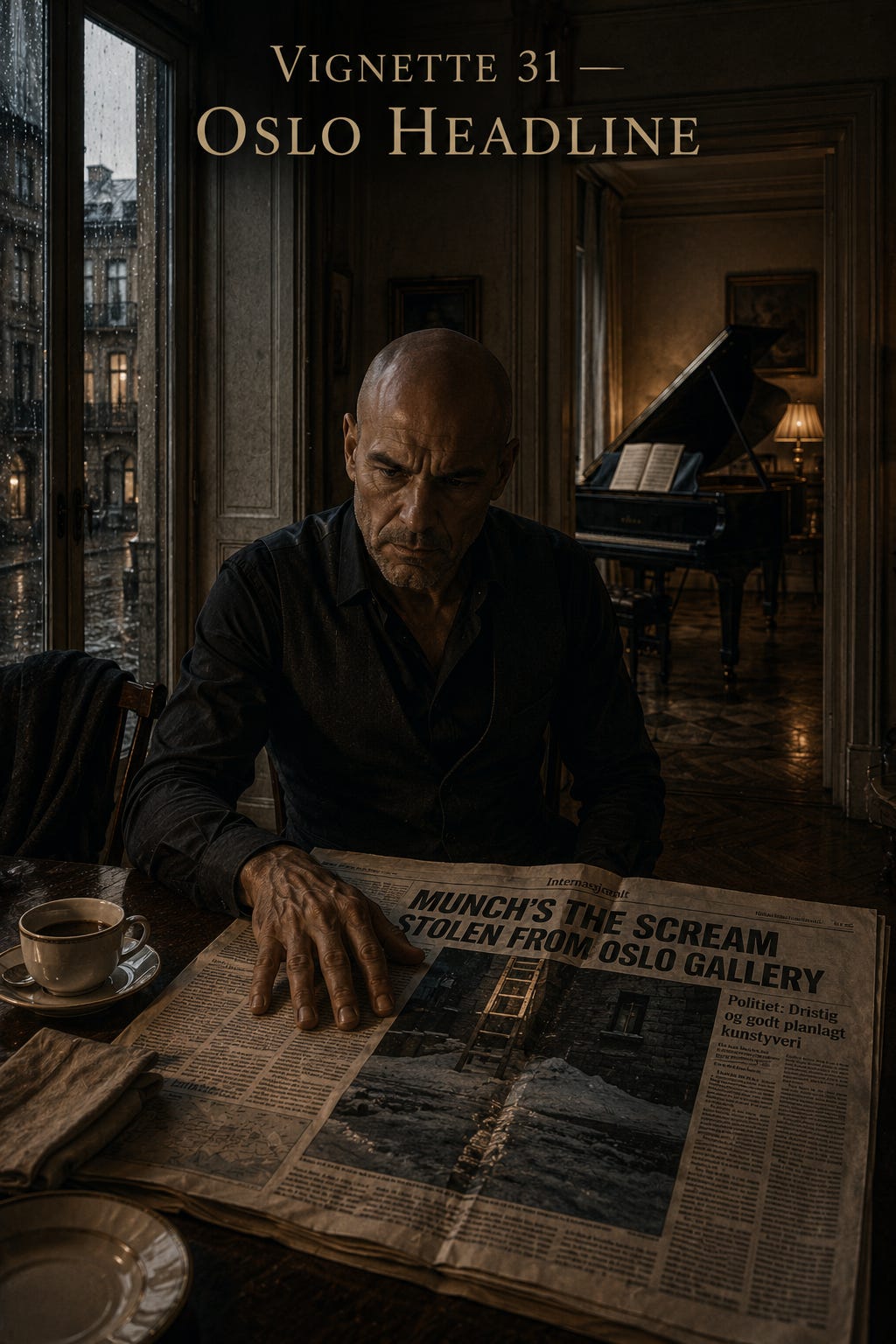
February 12, 1994 — Morning | Milan
The headline lay under his hand before the coffee had cooled.
MUNCH’S THE SCREAM STOLEN FROM OSLO GALLERY
The paper had been folded once by the kiosk man and once again by Isaac on the walk back to the apartment, but now it lay fully opened across the breakfast table with all pretenses removed: photograph, column, outrage, the city’s preferred morning arrangement of catastrophe and weather. Outside the tall windows, Milan held to its winter discipline. Rain had come in the night and left the courtyard below darkened into black stone and silver gutters. A pale sky hung above the facing walls with expensive reluctance. Somewhere below, a porter dragged open the heavier building door. Somewhere farther off, a tram bell marked the hour as though time itself had become municipal.
The apartment remained beautifully provisional.
A lamp still burned low in the reception room though daylight had arrived. The piano in the smaller room off the hall held the last of yesterday’s weather in its polished curve. A coat hung over the chair near the fire because he had not yet learned the room well enough to make his habits disappear inside it. One cup, one plate, one folded napkin. Enough signs of occupancy to suggest a life. Not enough to accuse him of believing in one.
He looked again at the paper.
The public version was already complete enough to offend him: bold theft, audacity, national treasure, humiliated museum, the insult of the thing committed while the world’s attention tilted northward for the Olympics. All of that would keep the morning alive for clerks and radio men and people who needed crime to arrive already simplified into a story with a center and a villain and a proper sequence of public feeling.
But beneath the adjectives the real grammar had begun.
He read that instead.
A ladder.
A window.
Speed.
A note left behind.
The kind of gesture newspapers preferred because it allowed thieves to appear theatrical and institutions to appear wounded in an intelligible language.
He did not care about the note.
He cared about the ladder.
Not the object itself.
The body that had used it.
He leaned back slightly in the chair, coffee cooling untouched at his right, and reread the paragraph describing the entry. The report was clumsy in the ordinary ways. Journalists wrote movement badly because they thought in nouns and aftermath rather than in the body’s mathematics. But the clues remained despite them. A ladder placed where stone and sill and timing made sense. A man up and over quickly enough to embarrass the room before the room knew it had been entered. Weight transferred through narrow space. The window not merely opened but read.
That was the word his mind supplied.
Read.
A window read for its weakness.
A wall read for the honesty of its resistance.
A museum read the way one read a private house after midnight and knew, from three feet inside the threshold, where it had once already admitted defeat.
He lifted the cup and drank once.
The coffee had gone slightly bitter while he was not looking.
Appropriate.
On the opposite wall the morning light caught the edge of a small painting he had allowed himself to place there a week earlier—not a confession, only a test. The room had held it well enough. Too well, perhaps. That was always the danger in temporary rooms: they learned the weight of selected objects quickly and then began suggesting the possibility of continuity where only arrangement existed.
He looked back to the paper.
The photograph beside the article showed the outside of the gallery under winter light, police presence already multiplying around the fact of violation. But it was not the public image that tightened him. It was something in the line beneath it—the route implied, the angle, the speed with which a body must have come through the opening and gone out again.
The body had recognized it before thought did.
That was what disturbed him.
He set the cup down very carefully.
Somewhere in the building a woman laughed once, sharply, then stopped. A door shut on the floor below. The apartment held its own silence around the newspaper as if aware that this was not the ordinary kind of reading morning rooms were built to flatter.
He remembered Stockholm.
The roof breach.
The black opening in the museum’s skin like a mouth the city had not known it possessed. That theft had interested him. Intellectually. Professionally. It had touched Verbruggen’s old note about roof access and reminded him how institutions often scheduled their own future wounds under the euphemism of maintenance.
This was different.
This theft had entered the body first.
He read the ladder line again.
The phrase was poorly written.
Too much emphasis on daring.
Too little on sequence.
Still, somewhere beneath the reporter’s clumsy admiration lay a thing almost tactile: a sense of a man ascending not nervously, not greedily, but in practiced relation to surface. A gait, almost. Not visible in the article, yet somehow left behind in it the way certain men left their shape in hallways even after the corridor had gone empty.
Isaac flattened the page with one hand.
The paper crackled under his palm.
A house at night came back to him—not fully, never fully, but with the same unpleasant bodily pressure that had begun returning in fragments since Boston. Vorin Dubmar’s world. The wrongness after. The sense that another intelligence had moved through that space with professional indifference while death, theft, and rearrangement were still in the act of becoming narrative. He did not remember a face. He remembered a route. The reading of a route. A line of exit. The aftermath held at the angle of a body no longer present.
And later—much later—those almost-prints, those partial disturbances in the scene’s retreat path, which he had read not as evidence exactly but as grammar.
He stood.
The sudden movement made the chair give a small complaint against the parquet. The paper remained open on the table. The headline stared up. The room changed scale at once, the way rooms did when one body shifted from reading to hunt.
He crossed to the smaller room where the piano stood and did not touch it.
The instrument had made the apartment listen, yes, but music was no use to him in this register. Music clarified emotion. What he required now was colder. He stood with one hand on the closed fallboard and looked out the window over the courtyard.
Below, the stone held winter rain in dark seams. No marks. No traces. No ladders leaned where they should not be.
Still, the sensation remained—not of being watched, which was too crude, but of having brushed a pattern before and now meeting its public echo in a newspaper from Oslo.
He thought then of Mercer’s office in Boston and the partial tread outside in the rain-dark pavement. Small enough to dismiss. Sharp enough not to. He thought of the routes Verbruggen had preserved in paper notations and clipped references, of how one mind could connect cities through methods long before police ever managed to connect them through law. He thought, unwillingly, of Marcelli saying that he read rooms, and of Isaac himself having always done the same under other names and better lighting.
A ladder.
A window.
A speed that felt less like haste than competence.
A note left behind for newspapers.
And beneath all that, the actual obscenity: a body moving through the breach with an economy that felt nearly familiar.
He returned to the table and read the article from the top once more, forcing himself this time through the public language. The note. The mockery. The obvious insult of the thing. Yes, all of that mattered to the world. But what mattered to him remained buried under the headline like structure under plaster.
How did he move.
How did he weight the sill.
How did he turn in the room.
How much time did he spend before removal.
What line did he choose on the way back out.
And why, reading this from Milan over bitter coffee in a rented apartment, did Isaac feel not merely professional interest, but the low bodily irritation of recognition denied a name.
He folded the upper half of the paper back.
Then opened it again.
Not enough.
He lifted it and carried it into the reception room, where the light lay differently and the table near the fire offered more room to spread the page beside his own notes. He did not yet take out Verbruggen’s folder. That would come next, perhaps, or later that day, or in the evening when the room had dimmed enough to make old papers behave honestly. For the moment he wanted only the article and his own reaction to it without outside arrangement.
He sat.
The fire had gone down to a useful low red. The room, at this hour, looked almost inhabitable. Dangerous. The newspaper lay across his knees, headline broad and black, the photo beneath it too public to be useful and yet still somehow harboring the route’s insult.
Why does this already feel remembered? he thought.
That was the real question.
Not who.
Not yet.
He looked toward the hall, toward the smaller room, toward the apartment’s closed door as if one of them might answer with architecture. None did.
At last he laid the paper flat on the low table and smoothed it once, too carefully, until the creases surrendered and the whole article lay obedient beneath his hand.
The gesture was unnaturally precise.
He knew it as he did it.
And because he knew it, the morning became worse.
This was no longer merely another theft in Europe, no longer merely one more public wound to be classified under route, appetite, and institutional embarrassment. Something in Oslo had crossed the page and entered his own private archive before permission had been granted.
The paper lay perfectly flat beneath his palm.
Outside, Milan kept its winter composure.
Inside, the apartment listened while Isaac, with the headline pinned beneath his hand like a specimen and a warning both, felt memory move toward him without yet agreeing to show its face.
To be continied…
By Noble Osborn