
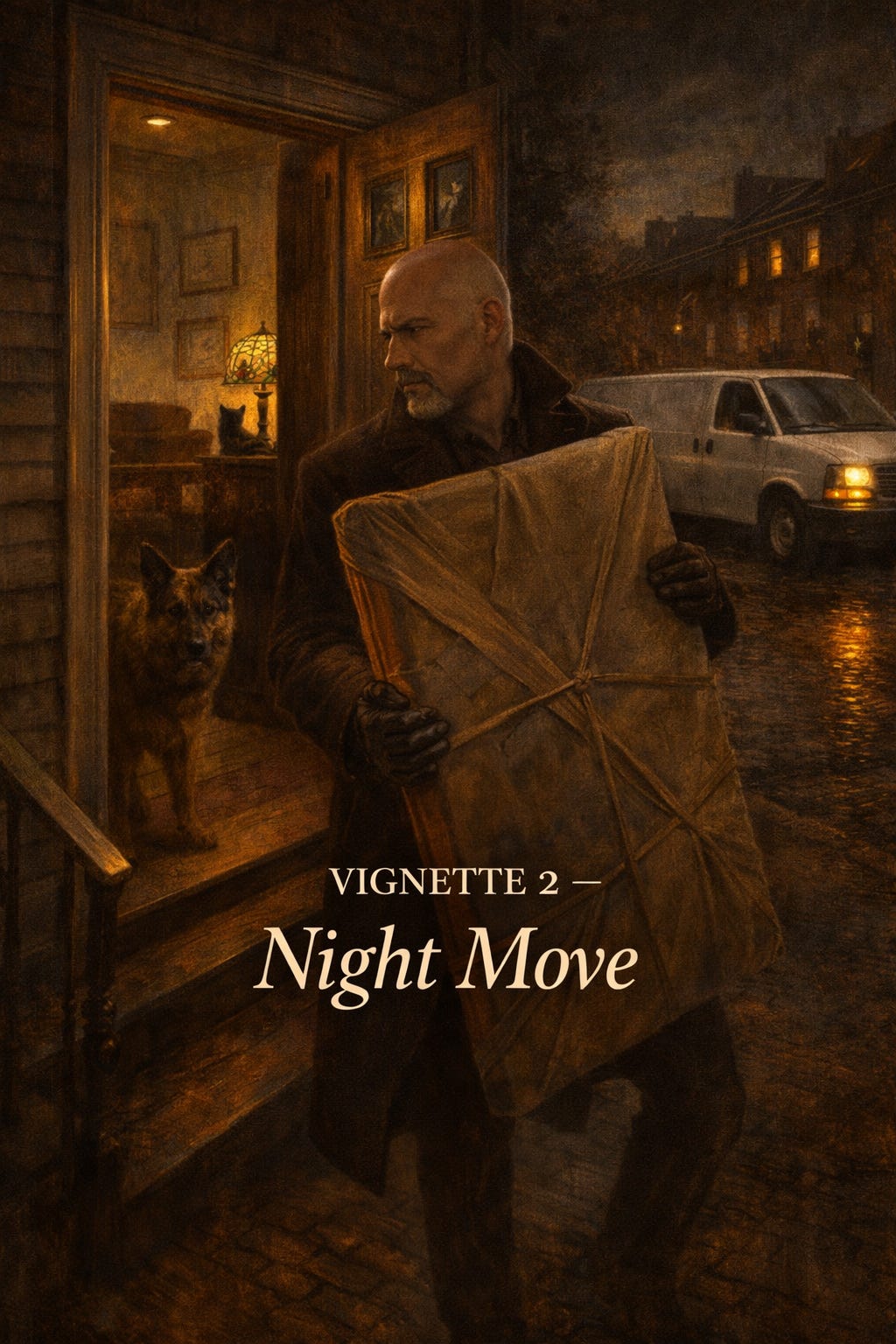
VIGNETTE 2 — Night Move
October 4, 1993 — After Midnight | 7 Moulder Lane, Boston
The van was white, anonymous, and offensively practical.
Isaac had chosen it for that reason.
Nothing about it suggested discernment. Nothing about it suggested value. It had no dark polish, no tailored discretion, none of the cultivated invisibility money preferred to mistake for safety. It was simply a rental box on tired tires with a dent near the rear quarter-panel and a faint smell of old cardboard, gasoline, and someone else’s bad coffee trapped in the upholstery.
Perfect.
He parked it half a house down from 7 Moulder Lane, not directly in front, not under the streetlamp, not where a sleepless neighbor might later remember it with too much accuracy. Boston after midnight had gone to brick and sodium light. The harbor air moved inland in thin cold ribbons. Somewhere farther down the block a bottle broke with the bright, brief conviction of other people’s disorder.
He shut the driver’s door softly and stood for a moment with the key in his hand.
The house looked watchful.
Its windows—too clean, still too clean—held the streetlight in hard pale squares. The front steps carried a skim of damp. The old clapboards, freshly attended in places and weather-worn in others, had begun to resemble the face of someone preparing to receive condolences without yet knowing from whom.
Isaac crossed the short stretch of path without hurry.
The front door gave under his hand. Inside, the house answered him with its usual sequence of narrow sounds: floorboards shifting, the old frame settling, the distant metallic opinion of a pipe, the whisper of air moving through space that had known too many secrets to mistake one more for novelty.
He locked the door behind him.
No lamp yet.
He knew the route in the dark.
The cats were already awake. He felt them before he saw them, two densities in the hall’s dim grammar. Metro glinted first—two green coins near the baseboard. Gnome appeared a beat later from beneath the console table, both of them offended by activity that arrived in boxes and silence rather than food.
Jaxon rose from the kitchen with a low exhale, joints thudding once against the floor before the rest of him followed. He came to Isaac, leaned into his thigh, and then turned his head toward the front room, toward the waiting labor, as if to say: well, then. Get on with it.
“All right,” Isaac murmured.
His voice sounded wrong in the dark.
He switched on the lamp in the front room and the Tiffany lovebird came alive in fractured green and amber over the carpet, over the edge of the rug, over the lower molding of walls that had held better things than paint. The room looked smaller with the paintings already gone. Not emptier, exactly. More exposed. Like a throat after a necklace had been removed.
The first load tonight would be frames too large and too dangerous to leave for daylight.
He had planned it carefully.
Smaller objects yesterday. Paperwork before that. The obvious surfaces thinned first, then the life hidden beneath them. Tonight required heft and judgment: what could be carried alone without inviting clumsiness, what needed padding, what could not scrape a banister or kiss a doorframe or suffer even one stupid accident born of fatigue.
He set the blankets out first.
Not the cheap quilted moving pads the rental agency had offered, but his own wool covers and felt sleeves, old and serviceable and clean enough not to offend varnish or age. He laid them over the sofa, across two chairs, along a cleared stretch of floor. A temporary surgical field for beauty.
His breathing steadied into count before the first frame was touched.
In three.
Hold.
Out to four.
Again.
The body remembered what the mind insisted was only labor.
He went to the wall where the small Dutch interior had hung for years in a pocket of good morning light. The rectangle of fresher paint behind it seemed less like absence than accusation. He stood before it briefly, not mourning the work itself—it was already crated safely elsewhere—but the way the wall now admitted what he had always known: no house was made safer by the beauty it contained. Only more desirable. More legible. More worth entering.
He lifted the first wrapped frame from where it had been propped against the baseboard and brought it to the blankets.
Metro leapt onto the sofa to supervise.
Gnome circled the felt edge once, suspicious of all textiles not presently committed to his comfort, then settled beneath the side table with the exact air of a magistrate attending a hearing destined to disappoint him.
Isaac worked without wasted motion.
Lift.
Wrap.
Tape the fold, not the frame.
Corner guards.
Second blanket.
Carry.
The hall was the worst part. Too narrow. Too memory-laden. Too willing to punish inattention with scraped knuckles and chipped wood. He angled the frame, pivoted at the shoulder, cleared the newel post by less than an inch, and felt the whole house lean close as if curious whether he would fail.
He did not.
At the door, he paused only long enough to listen.
Nothing outside but the patient cold.
He unlocked, opened, stepped through, and crossed to the van.
This was where the indignity of the thing mattered. No one seeing him now—if anyone was watching at all—would think masterpieces. They would think furniture, perhaps. A move. Divorce. Renovation. Some ordinary middle-class rearrangement too dull to deserve curiosity.
He hated the van for how well it served him.
Inside, the cargo space had been lined with additional felt and tiedown straps. He secured the first frame against the wall, not trusting the factory fittings, then stepped back and checked the angle as if the painting might shift its mind once in motion.
One down.
He returned to the house.
The second trip was easier only because the rhythm had begun. His body accepted the repetition. His mind, less so. Every room he entered now showed its wound more plainly. The front room losing proportion. The study stripped toward function. The upstairs hall reduced to banister, runner, shadow. Art had once made the house not generous, exactly, but persuasive. Without it, 7 Moulder Lane reverted toward structure and weather and old intent.
He found himself glancing toward the piano.
The Steinway waited in the music room, dark, shut, heavy with a silence unlike any other silence in the house. It would not move tonight. That would require specialists, discretion, money, timing, nerve. But already he could feel the gravity of leaving it behind even for a few days more. A house without art was exposed. A house without the piano was only partially itself.
Jaxon followed him from room to room, never underfoot, never intrusive, simply present. Once, on the third trip, the dog stopped at the threshold to the music room and looked in. Isaac stopped too. Man and animal stood side by side before the black shape of the instrument.
“Soon,” Isaac said.
He was not sure to whom.
By the fourth run the cold outside had sharpened. Breath smoked briefly each time he stepped through the front door. The van’s cargo space had begun to smell faintly of wool, wood, and the restrained panic of valuable things handled in darkness. One frame was awkward enough that he had to take the front steps more slowly than he liked. On the sidewalk, he felt Jaxon watching from the window and almost laughed at the absurdity of finding comfort in being observed by his own dog while conducting what, to any honest language, was the burglary of his own life.
On the fifth pass he stopped in the front room and looked around.
The Tiffany lamp had stained the walls into mourning colors. Metro had abandoned the sofa for the piano bench. Gnome now occupied one of the folded blankets with proprietary contempt. The room was not yet empty, but it had crossed some internal border into aftermath.
He pressed his knuckles briefly to the bridge of his nose.
Too slow would be dangerous.
Too fast would be worse.
In three.
Out to four.
He lifted the next frame.
When at last he slid the van door shut on the first full section of the house’s private world, the sound carried down the block in a single contained metal sentence.
Not dramatic.
Not final.
But sufficient.
Isaac stood with one hand still resting on the handle, the cold metal against his palm, and looked back toward 7 Moulder Lane.
The windows gave nothing away.
Behind them, the house kept its posture. Inside, the cats remained at their posts. Jaxon would be waiting near the hall when he returned for the next load. The Steinway still held its ground. The walls had begun learning how to live without witnesses.
He took the van keys from his coat pocket, turned them once in his fingers, then slipped them back.
This was only the beginning.
But the house had now crossed the first threshold.
It was no longer being lived in.
It was being removed.
To be continued…
-By Noble Osborn