
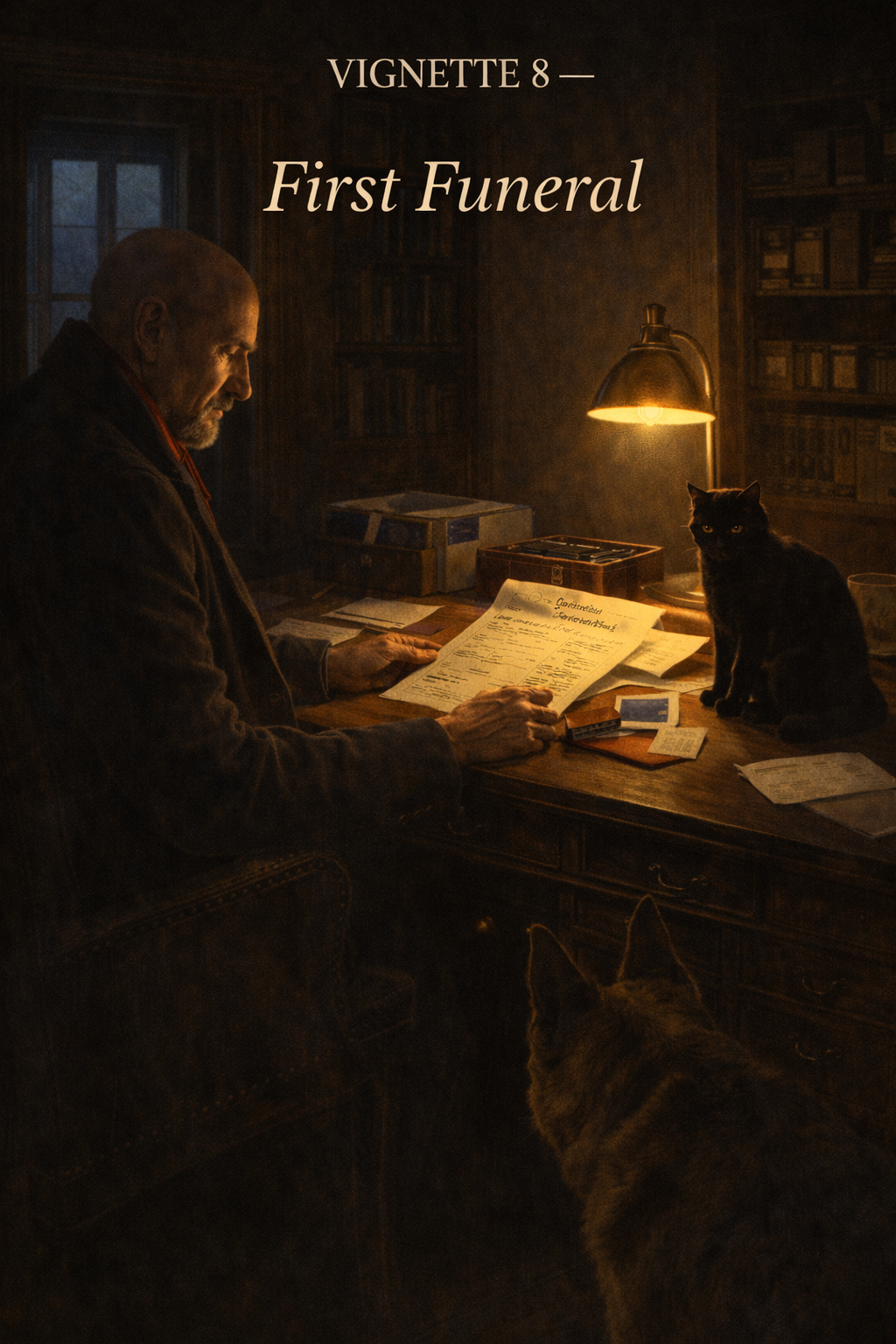
October 14, 1993 — Early Evening | 7 Moulder Lane, Boston
The death occurred in Marseille at 3:17 in the afternoon.
At 9:42 that evening, it arrived in Boston folded inside a cream business envelope with no return address and a hotel receipt paper-clipped to the top as if grief, too, required itemization.
Isaac carried the envelope into the study and did not open it immediately.
The house had settled into one of its rare obedient silences. No painters now. No ladders. No men with brushes turning old damage into marketable amnesia. The fresh paint smell still lingered faintly in the front room, but here in the study it had lost its edge beneath older notes: leather, paper, cedar, and the dry interior weather of rooms that had stored too many decisions.
The desk lamp cast its amber pool.
The rest of the room remained disciplined.
Metro occupied the window seat with the full theatrical dignity of a cat who believed the city existed principally to disappoint him. Gnome had taken up position under the desk, invisible except when his eyes opened. Jaxon lay across the threshold, not asleep, merely horizontal.
Isaac slit the envelope with the bone-handled letter opener and removed the contents one by one.
First, a photocopy of the hotel registration card.
HOTEL DU PHARE
Rue Sainte, Marseille
ELLERY HAWTHORNE, M.D.
The handwriting on the card was his own, though years old now, one of several practiced versions of the man. The room number had been added by the desk clerk in blue ink. Two nights paid in advance. No guests. No vehicle. No special requests.
Blandness, preserved.
Beneath that came the doctor’s note.
Short.
Local.
Sufficient.
Middle-aged male.
Traveling alone.
Cardiac event in room.
No sign of foul play.
Body removed with routine discretion.
Routine discretion.
The phrasing was almost pretty.
Last, folded once with the legal neatness Mercer seemed to prefer, came the death certificate.
Isaac unfolded it fully and laid it on the desk blotter.
Name: Ellery Hawthorne.
Nationality: American.
Occupation: Physician.
Cause of death: Acute myocardial infarction.
Place of death: Marseille.
Personal effects released to administrative contact.
The paper itself was ordinary. Government stock. Thin enough to curl slightly beneath the heat of the lamp. A seal in one corner. A signature in another. An official stamp impressed too hard at one edge so that the ink broke slightly on the page.
Nothing theatrical.
Mercer had been right.
A man like Ellery Hawthorne did not deserve flames.
Ellery deserved a hotel room, good linen, discreet staff, and a heart that had simply chosen not to continue.
Isaac sat very still with the certificate before him.
On the line labeled age, the number disturbed him more than anything else on the page.
Not because it was inaccurate.
Because it was accurate enough.
Ellery had been built from qualities the world found comforting in a man: mild authority, educated reserve, decent shoes, conservative ties, a physician’s practiced stillness. He was useful in airports, hotel lobbies, private clubs, discreet crossings, places where people wanted reassurance more than scrutiny. Ellery listened well, interrupted rarely, and looked like the sort of man who would tell you something unwelcome with tact. He had crossed borders for years under the protection of other people’s instinctive trust.
Now his trustworthiness had killed him.
Isaac reached for the hotel receipt clipped to the top of the stack.
Mini-bar untouched.
One supper charged to the room: broth, bread, grilled fish.
Two calls.
One pressed shirt.
He almost smiled at that.
Even dead, Ellery had left behind tastefully boring evidence.
The whole construction was excellent. Not flawless—nothing involving paper ever truly was—but excellent. A man alone in Marseille. A decent hotel. A heart no one could argue with. Enough bureaucracy to close the file. Not enough drama to reopen it.
And yet.
Isaac lifted the registration card again and looked at the signature.
He remembered the first time he had signed Ellery’s name in public.
Geneva, years ago, in a hotel where the concierge had apologized for a delayed car as if admitting moral failure. Ellery had worn charcoal that trip and carried a medical conference brochure folded into the inside pocket of his coat. The lie had not even needed to be particularly clever. People liked doctors. They offered doctors privacy the way they offered priests confession: reflexively, and often without deserving either. One customs official in Zürich had spoken to him for almost ten minutes about migraines before waving him through with an embarrassed smile and a blessing.
Ellery had been useful because Ellery soothed.
No one expected soothing men to transport danger.
Isaac set the registration card down and rubbed his thumb once over the stamp on the death certificate until he felt the slight roughness where the ink had dried too thickly.
From under the desk came the quiet sound of Gnome repositioning in his sleep.
Jaxon, still at the threshold, lifted his head once and watched him.
“What,” Isaac said softly, not really to the dog, “is the proper response to this?”
Jaxon lowered his head again, declining philosophy.
Outside, a car moved too quickly over the damp street and was gone. Somewhere in the kitchen a pipe ticked. The house held around him with the worn patience of a place that had already outlived several of his better fictions.
He turned back to the certificate.
The disorientation came not from grief. Grief required belief. No one grieved a fabrication in the ordinary human sense. What unsettled him was intimacy. Ellery Hawthorne had never existed independently of Isaac’s body, yet the paper now insisted on an ending specific enough to make absence feel factual. A room in Marseille had held his name. A clerk had spoken it. A doctor—real or paid to resemble one in exactly the right way—had written it into cause and consequence. Somewhere a municipal file now contained Ellery’s death among a thousand other weekday endings no one would ever read twice.
The world had made room for him just long enough to erase him properly.
That was the part Isaac had not anticipated.
He had commissioned removal and received, instead, mortality arranged with taste.
He rose and crossed to the cabinet wall.
The safe opened under his hand with its familiar double mechanism, less like welcome than recognition. The shelf of false men stood where he had left it, diminished now not in number but in certainty. There, between Anton Weiss and Nicholas Reid, rested Ellery’s remaining papers: backup passport, insurance card, club membership, a soft leather wallet containing the pleasant detritus of a man designed never to trouble anyone. A receipt from Vienna. A dry cleaner ticket from Basel. A London Underground stub folded twice. A prescription pad page torn cleanly at the edge.
He removed them one by one and carried them back to the desk.
The wastebasket would have been ridiculous.
Fire, too dramatic.
Instead he opened the lower drawer, withdrew the flat archival box he had already prepared, and laid Ellery’s remnants inside with the calm, terrible care of an undertaker dressing a body no family would claim.
Passport first.
Then cards.
Then receipts.
Then the little photographs.
Then the wallet emptied of the small comfortable lies that had once given him contour.
Metro leapt down from the window seat and onto the desk without asking permission, landing beside the death certificate with a softness that made the seal on the page seem even more absurdly official. He sniffed once at the edge of the paper, found mortality bureaucratically uninteresting, and sat with his tail wrapped over his front paws.
“Exactly,” Isaac murmured.
He folded the certificate again and placed it atop the box’s contents.
Not buried yet.
Not destroyed.
Merely arranged.
A first funeral.
Through the floorboards the house gave one long faint settling sound, as if somewhere deep in its frame something had accepted new weight.
Isaac closed the archival box and slid it into the back of the drawer.
Ellery Hawthorne, physician, had died in Marseille of a heart too ordinary to dispute.
Some clerk would file him.
Some ledger would close.
Some system would grow more comfortable because his name now ended where systems preferred names to end: beneath a seal, beneath a signature, beneath the plausible indifference of foreign paper.
Isaac returned to the chair but did not sit at once.
He stood looking down at the cleared space on the desk where the documents had been.
The emptiness there was wrong in a way no evidence of death had been.
That, he understood now, was the true obscenity.
Not that Ellery had died.
That he had died neatly enough to leave behind order.
In the hallway Jaxon rose, shook once, and came to lean his shoulder against Isaac’s leg. The pressure steadied him, though he would not have named it that. Metro remained on the desk like a black magistrate attending proceedings. Gnome slept on, unimpressed by legal extinction.
Isaac sat at last, reached for the untouched whiskey, and took the first swallow of the evening.
It had warmed under the lamp and gone slightly flat in the glass.
He drank it anyway.
Then he drew Mercer’s folded page from his inner pocket, opened it beside the blotter, and looked down at the remaining two deaths still waiting to be assigned their countries.
Marseille had taken the first man cleanly.
Trieste waited.
Lyon waited.
The shelf in the safe had grown lighter by one pulse.
He put the glass down and listened to the house breathing around him.
For the first time since the envelope arrived, he allowed himself the smallest concession to feeling.
Not sorrow.
Not guilt.
Only the strange bodily wrongness of surviving someone who had never existed without him.
To be continued…
-By Noble Osborn