Deep Freeze
When a Church Pauses a Person

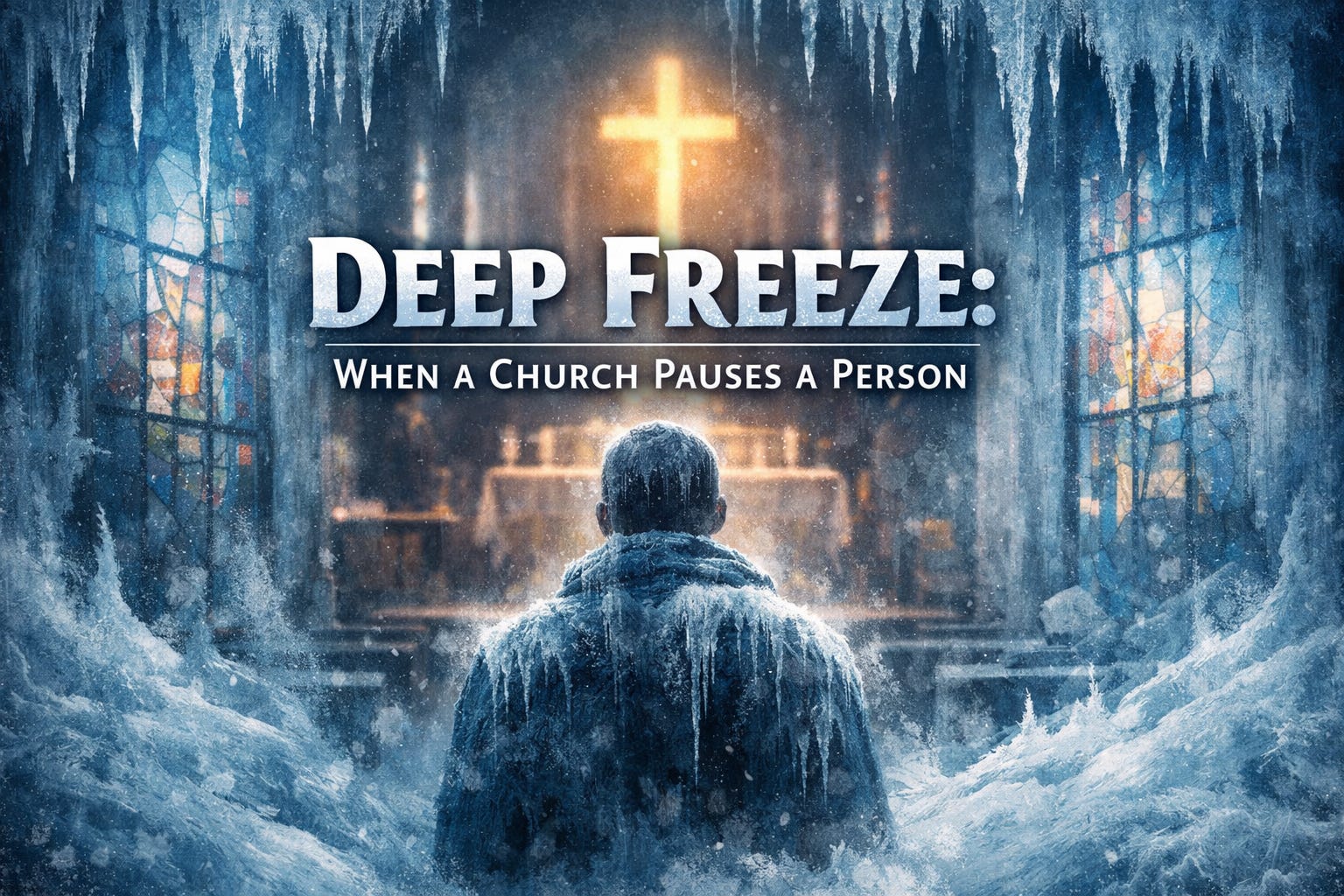
On a February afternoon in London, the Church of England did what institutions often do when the room goes quiet with grief: it reached for procedure.
The General Synod voted to halt the Living in Love and Faith process—three years of formal work meant to find a way forward on relationships, sexuality, gender, and the church’s posture toward LGBTQ people. The vote wasn’t a tidy conclusion. It was a confession of stalemate: bishops said consensus could not be reached. So the work is put on ice until a new Synod is seated, and the church returns—again—to the long corridor of “not yet.”
If you don’t live inside ecclesial language, “pause” can sound gentle, even compassionate. A pastoral time-out. A chance to cool down. But for the people who have spent years waiting to be recognized as fully human in the place where they were baptized, confirmed, married, ordained, buried—pause doesn’t land as neutral. It lands as a strategy.
Because the waiting is never distributed equally. The waiting always has a body.
The decision means the proposals for clergy to conduct stand-alone blessing services for same-sex couples in civil marriages will not go forward. It means the prohibition on clergy entering same-sex civil marriages remains. And it means that the church’s partial accommodation—the “Prayers of Love and Faith” that clergy may use within regular services—continues to function as both concession and containment: a way to say something without changing what the church is willing to say it believes.
In the debate, some Synod members tried to name what “pause” costs. A London priest and equality campaigner, Charlie Bączyk-Bell, spoke with the rawness of someone who has heard too many apologies that arrive with an invoice attached. He told the room his heart was broken, and asked what kind of church can recognize pain while continuing to inflict it. Another priest, Claire Robson, spoke from a different angle of the same wound: time. She said the changes many long for will come too late for many of them.
Time is the quietest weapon in governance. You can’t photograph it like a bruise. You can’t quantify it like a budget line. But it can hollow out a vocation, erode a marriage, and teach a queer teenager exactly how conditional their welcome is.
That is why this story is not only about theology. It is about legibility—who is recognizable as a full person inside a community that still shapes schools, charities, chaplaincies, and civic rituals. When the established church hesitates, its hesitancy doesn’t stay inside church walls. It drifts outward into public life like incense: into the tone of a school assembly, the assumptions of a hospital chaplaincy, the moral imagination of a local food bank, the quiet authority that still clings to a bishop’s collar in national conversation.
And it is also why “pause” is not merely inaction. It is an action that protects existing power arrangements while appearing careful. It buys institutional time at the expense of personal time. It turns human lives into a calendar problem.
The bishops framed the vote as a sensible next step after a bruising process. The Archbishop of Canterbury, Sarah Mullally, said the process has “left us wounded as individuals and a church.” The Archbishop of York, Stephen Cottrell, acknowledged anger and disappointment across party lines, and spoke of the church’s inability to find a way forward that honors conscience on both sides.
Conscience is real. Many faithful Christians read scripture and tradition and arrive at different conclusions, and some experience proposed change as spiritual violence against what they believe the church has received and must safeguard. If you want to understand the Church of England’s paralysis, you have to take that claim seriously—not because it outweighs queer lives, but because it explains the shape of the institution’s fear.
The Church of England is not only a church; it is a communion of compromises. It has trained itself to survive by holding contradictions in the same hand. When you ask it to name what it believes about marriage and holiness in the bodies of queer people, you are asking it to choose what kind of unity it is willing to lose.
But this is where the moral question becomes unavoidable: what kind of unity is maintained by sacrificing a minority’s dignity, decade after decade, while calling the sacrifice “discernment”?
Institutional churches often narrate delay as humility—“we must listen,” “we must proceed carefully,” “we must not move faster than the Spirit.” Yet delay can also be a way of keeping control over who gets to be hopeful. It can be a way to make LGBTQ Christians do the work of patience on behalf of everyone else.
There’s another layer that makes this “deep freeze” more than a British story: the global Anglican ripple effect. The Anglican Communion is not a single polity. It is a family of provinces that share history, liturgy, and conflict—but not uniform law. When the Church of England debates LGBTQ inclusion, it is not merely adjusting its internal furniture. It is signaling. And signals travel.
Decisions in England can be weaponized elsewhere in two opposite directions. In some places, they become proof that “the West” is corrupting the faith—fuel for politicians and preachers who want a moral panic and a scapegoat. In other places, they become a fragile lifeline—evidence that change is possible, that the church can move, that God’s blessing is not rationed by heteronormativity.
This is the paradox: a church “pausing” in London can intensify pressure on queer Anglicans in countries where LGBTQ people already face criminalization and violence. It can also intensify pressure on queer Anglicans in England who have been told, for years, that they must wait because the global communion might fracture if they are treated as equals.
Either way, the queer person becomes the bargaining chip. Their body becomes the bridge everyone else crosses to get to their preferred future.
So what does “staying vs leaving” look like when the harm is administered by committee?
For some LGBTQ Anglicans, staying is an act of sacred stubbornness. They refuse to surrender the church to those who would narrow it. They remain in their parishes like candles that will not be blown out—teaching Sunday school, singing in choirs, visiting the sick, running the food pantry, preaching the Gospel with a tenderness the institution has not earned. Staying becomes a vow: I will not let you exile me from God.
But staying also has a cost. Not everyone can keep offering their spiritual labor to a structure that keeps postponing their humanity. There is a difference between patience and self-erasure. There is a difference between carrying a cross and being nailed to it by policy.
For others, leaving is not abandonment; it is survival. It is the decision to stop volunteering as the church’s open wound. Some leave for denominations that affirm them fully. Some leave Christianity altogether. Some leave quietly, without a social media exit letter, because they are tired of explaining why a church that says it loves them keeps arranging their life as an exception.
Leaving can be a sacrament too: a refusal to normalize harm.
And then there are those who live in the ache between. They stay in the pew but not in the meetings. They pray but no longer volunteer. They love the liturgy but no longer trust the leaders. They keep the faith the way someone keeps a photograph after a divorce—proof that the love was real, even if the relationship became impossible.
If you want to understand what this Synod vote does, don’t start with bishops. Start with the small, ordinary moments where policy becomes flesh.
A priest scanning their diary and realizing the person they love will never be blessed in a way the church will publicly name without caveats.
A gay teen who hears “we’re pausing” and learns, immediately, that their life is a topic, not a person.
A heterosexual parishioner who wants to support their queer friends but feels trapped between loyalty to tradition and loyalty to people they actually know.
A bishop who believes change is necessary but fears schism, and has made fear into a theology of slowness.
A queer Anglican in another province watching England hesitate and hearing local leaders translate that hesitation into permission: see, even they can’t call you blessed.
None of these people are abstractions. They are the church.
And that is the core scandal: the institution speaks as if it is protecting “the church,” while making the actual church—its living members—pay the price.
The Synod has chosen to end one formal process and begin another. New groups will be formed. New language will be drafted. New apologies will be offered. The machinery will keep moving, because institutions can always find a way to continue without resolving.
But LGBTQ Christians are not an agenda item that can be rescheduled. They are already here. They have always been here. They will be here when the next Synod convenes, when the next working group files its report, when the next carefully written statement tries to sound like compassion while functioning like delay.
What would it look like for the Church of England to stop treating equality as a risk to manage and start treating exclusion as the emergency?
It would look like telling the truth about time. About whose lives are being spent to purchase institutional calm.
It would look like admitting that unity maintained by withholding dignity is not unity; it is quiet coercion.
It would look like refusing “pause” language when the lived effect is ongoing harm.
It would look like bishops speaking plainly: either the church believes queer love can be holy, or it does not. Either queer clergy can be married without penalty, or they cannot. Either the church will bless what it currently treats as second-class, or it will keep dressing inequality in pastoral words.
And if the fear is fracture, then name the fracture honestly: not as something queer people are causing by existing, but as something the institution has already created by making their belonging conditional.
Brushstrokes & Faultlines will be pursuing this story through the voices institutions tend to flatten: LGBTQ clergy, parishioners, and bishops—across at least two continents—speaking about what staying costs, what leaving protects, and what spiritual harm looks like when it arrives in a committee paper instead of a shouted slur. If you have lived this tension inside Anglican life, your testimony matters. Not as a “perspective,” but as evidence.
Because this is not an argument about abstract doctrine. It is a fight over who gets to be seen as a full person at the altar.
And no church should be allowed to call someone beloved while keeping them on ice.
-By Noble Oborn